Kiambu County Turns to Solar, Powering Boreholes and Cutting Costs
By Esther Kihanya
Kiambu County is making a bold shift towards sustainable energy by solarizing boreholes to ensure reliable, affordable and sustainable access to water.
Through the Department of Water, Environment, Natural Resources, Energy and Climate Change, the County has launched a program to solarize all boreholes and cure the problem of unsustainability where community water projects grapple with huge bills and massive amounts of the revenue going towards payment of electricity bills.
“In the past, the county used to drill and equip boreholes then use a motor to pump the water using grid power. My administration is changing this trend by adopting solar power, renewable energy, which aligns with the global climate solutions,” said Governor Kimani Wamatangi.
The journey of adopting solar for boreholes in Kiambu County began at the Kikuyu Municipality where the pilot project was undertaken.
“We have recorded a drastic reduction in power costs by 30–40% at the Kikuyu borehole. Previously, Kikuyu Water and Sanitation Company paid more than KSh 7 million monthly to Kenya Power, but with solarization, this has dropped by over 40%,” said CECM David Kuria
The success at the Kikuyu borehole was replicated at Gathanji borehole where residents enjoy more regular water supply.
“We suffered a lot without water since we could go for even more than two weeks without water supply. I was forced to buy water or fetch from the river, but now we get water frequently because of the solarization,” said a resident, Mbugua Thiong’o.
Governor Wamatangi emphasized the importance of the Gathanji project to the overall wellbeing of the citizens, and for them to lead a more productive life.
“We drilled and solarized the Gathanji borehole to ease the suffering of the community and provide them with sustainable access to clean water. Solar energy makes this affordable and reliable, “ said Governor Wamatangi.
The solarization initiative is expected to reduce the county’s water bill from over KSh 800 million monthly to around KSh 400 million or less. This will free up resources for the county, allowing water companies to invest in expanding water access and other development projects.
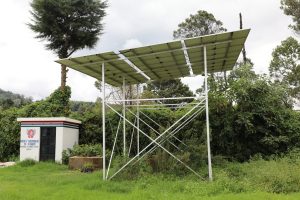
Lari, DCC Area Water Project
The adoption of solar energy for boreholes is part of Kiambu’s broader vision of the adoption of green energy solutions across public facilities, including street lighting.
Since Governor Wamatangi assumed office, more than 250,000 residents have been connected to water, raising coverage to 75% across the county.
Thousands of Solar Lights Brighten Life in Kiambu County
BY ANNEGRACE NJOKI
Kiambu governor Kimani Wamatangi has operationalised the solarization streetlighting in efforts to cut the huge power bills that have jeopardised the county’s development.
The County spends over a billion shillings on power bills annually, and the adoption of renewable energy is a strategic move, which will offer a massive relief to the county funds.
The move has also brightened the life of the residents who boast of enhanced security, increased business hours, and because of the deliberate attempt to cut the funding towards lighting.
The KES 400 million solar project, actualized in three phases, will include the solarization of the street lights across the county, and/or transitioning county-run hospitals from the national grid to solar, and also county offices.
“The residents of Kiambu have reported enhanced security, and extended business hours because of the solar lights. The non-reliance on the grid also rids the wards from constant blackouts, says Governor Wamatangi.

Governor Kimani Wamatangi Solar streetlighting in Kiambu Municipality
The street lighting program dubbed Angaza Kiambu will save county funds through a low maintenance cost, and their dependency on the naturally available sun and light. The solar lights are also more durable.
“The solar project aligns with the SDG 7 on affordable and clean energy,” said Governor Wamatangi. He was optimistic that Kiambu County could be the first in the region to go green, which was a measurable action towards climate change mitigation.

Solar streetlighting Kiambu Municipality
County Climate Change Director Ms. Esther Kaguima noted that the project was strategic in efforts to reduce carbon emissions across the globe.
The first phase included the installation and launch in Limuru, Githunguri, Juja, Ruiru, and Kiambu sub-counties. The residents lauded the county’s efforts to improve the business environment and also enhance security.
Peter Wakaba from Juja, Malaba area, said that the solar lights would help keep at bay wild animals, like the hyenas, which roamed the wards especially when darkness fell.
“It has been unsafe walking and working in the dark, particularly with the hyenas roaming around. This solar initiative is enhancing security and we can now extend our business hours,” he added.
Utilities Chief Officer Ms. Virginia Kahonge added that the project would enhance efficiency as the constant disruptions on the national grid due to owed bills would reduce. “While we are gradually moving towards solar energy, the power cuts due to unsustainable power bills will be a thing of the past,” she noted.